Media Servers
Connect media servers so their live TV guides refresh automatically after each EPG generation. Configure under Settings → Media Servers.
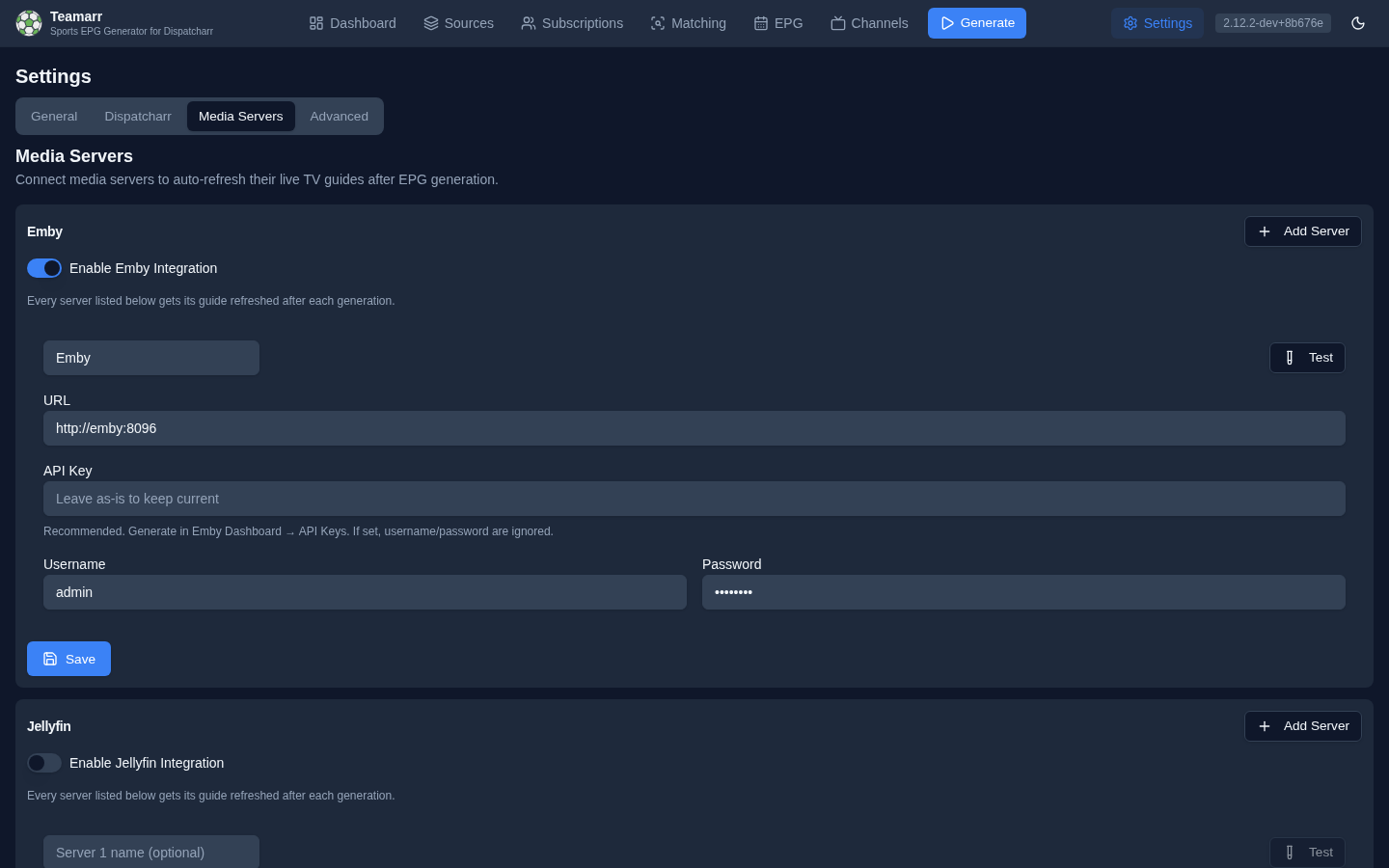
All three integrations support any number of servers, and every configured server across all three refreshes in parallel after generation — one slow or offline server never delays the others.
Each integration has its own Enable toggle — a configured-but-disabled integration is silently skipped, so if a server never refreshes, check the toggle first. Every server row has a Test button that reports the connected server and version. Rows added without a URL are dropped on save.
Emby / Jellyfin
Each server entry takes a URL and either an API key (recommended — generate in the server dashboard) or username/password. Click Add Server for additional servers; an optional name keeps logs readable. After each generation Teamarr triggers a guide refresh on every entry so new programmes appear without waiting for the server’s own scheduled refresh.
The refresh triggers the server’s own Refresh Guide scheduled task and waits for it to complete (with live progress, up to 5 minutes) — that’s why a generation run can sit near the end while a slow server churns.
Jellyfin 10.x and 12+ are both supported: Teamarr authenticates to Jellyfin with the standard Authorization: MediaBrowser … header rather than the legacy X-Emby-Token header that Jellyfin 12 removed.
Saved secrets display as ******** — leave them as-is to keep the stored value, or type over them to replace.
A failed refresh never fails the generation — but it is recorded. Each run stores every server’s outcome (success, duration, error) with its run stats, and once a server has failed three consecutive runs the Dashboard status strip shows a Media servers … not refreshing warning (hover for the error) and the support bundle raises a media_server_refresh_failing signal. If you see it, check the URL first: a server that moved hosts fails instantly on every run and is otherwise invisible.
Channels DVR
Channels DVR splits channel-list and guide data into two providers, so Teamarr refreshes both — sequenced, each step confirmed against the server’s log before the next:
- M3U Source — the custom channels source that pulls from Dispatcharr (
POST /providers/m3u/sources/<name>/refresh); Teamarr waits for the server to confirm the lineup refreshed - XMLTV Lineup — the guide data source for those channels (
PUT /dvr/lineups/<id>); Teamarr waits for the guide fetch and airing re-index to complete. Without this the channels update but the guide stays stale. If you don’t pick a lineup, Teamarr derivesXMLTV-<source name>automatically.
Both dropdowns are discovered live from the server once a URL is set (a saved selection that no longer exists on the server is flagged “not found on server”). The local Channels DVR API is unauthenticated by design — no credentials needed.
Multiple servers
Useful when several households or locations share one Dispatcharr: click Add Server and give each entry its URL, M3U source, and lineup. Every listed server receives the same channel set and EPG. The east/west or per-household split (which channels each DVR actually shows) lives in Dispatcharr profiles, not in Teamarr.
Times shown inside programme titles/descriptions come from your templates and render in Teamarr’s EPG timezone. Guide grid times always render in each client’s local timezone automatically — XMLTV timestamps carry offsets. If your servers span timezones, avoid time-of-day template variables rather than looking for per-server EPGs.